Share this post

NOVEMBER 5, 2026
Most mortgage products begin with a home. A land loan begins with what might be built someday.
That uncertainty makes financing a land purchase one of the least understood corners of the mortgage market. There’s no completed house to inspect and no guarantee the buyer’s vision will work on the parcel.
What does the zoning allow? Are wetlands involved? Is there legal access? How close are the utilities? Have approvals been secured, and will they still be valid if the owner eventually decides to build?
Ten attractive acres can become 10 unusable acres pretty quickly if nobody asks the right questions.
“Land loan” can mean very different things.
Mention a land loan and many people picture a working farm, a large rural property or a developer preparing an entire subdivision. A smaller residential-use parcel is a different transaction.
The buyer may be looking for land with no immediate plan to break ground. The objective is to secure the right property while it’s available and hold it as an investment.
Finding a lender for that use can be surprisingly difficult. Many conventional mortgage lenders don’t finance vacant land. Agricultural lenders may have little interest in smaller residential parcels. Other institutions finance a land purchase only as the first step toward their construction loan. Even when the construction loan isn’t tied to the land financing, some lenders will consider only an improved building lot, with items such as utilities, access or other site work already in place.
The few options available may come with conditions the buyer isn’t expecting: They think they’re financing a piece of land. They may also be starting a construction clock they aren’t ready for.
Once the clock starts, the borrower is on the hook.
With some lenders, the clock begins at closing. The borrower may have as little as two years to start construction and may be pressured to return to the same institution for the construction loan.
Two years sounds like plenty of time until the real work begins: surveys, engineering, zoning, permits, plans, builder selection and a realistic budget. One setback can move everything behind it. A zoning question delays the plans. The plans delay the estimate. The new estimate changes the budget. And the property isn’t the only variable. A job loss, relocation or health issue can change the owner’s plans just as quickly.
Meanwhile, the maturity date isn’t moving.
As it approaches, the borrower needs finished plans, an approved builder and construction financing. (Better hope every piece falls into place, because this is probably the worst time to start shopping around.)
There’s another question worth asking: If the borrower is already prepared to build, why begin with a land loan at all?
A construction loan often makes more sense from the outset. Why close on the land and then close again on construction financing, paying another set of closing costs along the way?
A land loan serves an earlier stage. The buyer wants to acquire and hold the property, but there isn’t a construction project ready to finance. Purchasing the land independently may also preserve the freedom to compare builders, refine the design and arrange construction financing later, if the owner decides to build.
The project should start when the site, plans and owner are ready, not when the land loan says time’s up.
A buildable lot is worth more than a beautiful listing.
People like to say they aren’t making any more land. They’re right, but scarcity alone doesn’t make a parcel suitable.
A parcel approved for residential construction may have cleared a major hurdle. But “approved building lot” isn’t a phrase buyers should accept without further explanation.
Is the parcel zoned for the intended use? How many units are permitted? Have septic, well and utility questions been addressed? Are there setbacks or easements that restrict where a structure can sit? Do the approvals expire?
The answers vary dramatically by location. Cross a state, county or even town line and a nearly identical parcel may be subject to a different set of rules. Accessory dwelling units are a good example. State-level reforms are opening the door to second units in some communities, including detached structures and garage conversions, even where local zoning once made them difficult or impossible. The parcel may be the same. What the owner is allowed to do with it may not be.
The National Association of Home Builders has described zoning reform as central to the nation’s housing strategy, citing persistent shortages, rising costs and regulatory frameworks that can inhibit production.1 For an individual buyer, that national debate comes down to one question: Can this property support what I may eventually want to build?
A listing description can’t answer that.
Buildable land is already in short supply.
Freddie Mac estimated that the United States was short approximately 3.7 million housing units as of the third quarter of 2024.2 The gap persists even as the country continues building.
In August 2026, single-family building permits were running at a seasonally adjusted annual rate of 878,000.3 The National Association of Home Builders reported that builders continued to face higher construction financing costs, affordability pressure, rising building costs, land scarcity and labor shortages.4
One parcel won’t solve a national housing shortage. But new homes can’t be built without suitable land, and a desirable, buildable lot may be difficult to replace once the opportunity passes.
For a financially prepared investor who has identified the right parcel, purchasing it can preserve future options. The financing shouldn’t force the owner to exercise those options before there’s a project ready to move forward.
Land requires a different conversation.
Two neighboring parcels may look nearly identical while carrying very different possibilities. One may support residential construction. The other may have access problems, agricultural restrictions, wetlands or an appraisal that doesn’t support the intended use.
Mortgage professionals familiar with land loans know which questions need answers before price becomes the main conversation. They can help borrowers understand how the property will be evaluated, what documentation a lender may require and whether the financing comes with an obligation to build.
For more on the broker’s role in complex transactions, read my article The Mortgage Broker Is the Person Borrowers Remember.
Why Quorum separated the decisions.
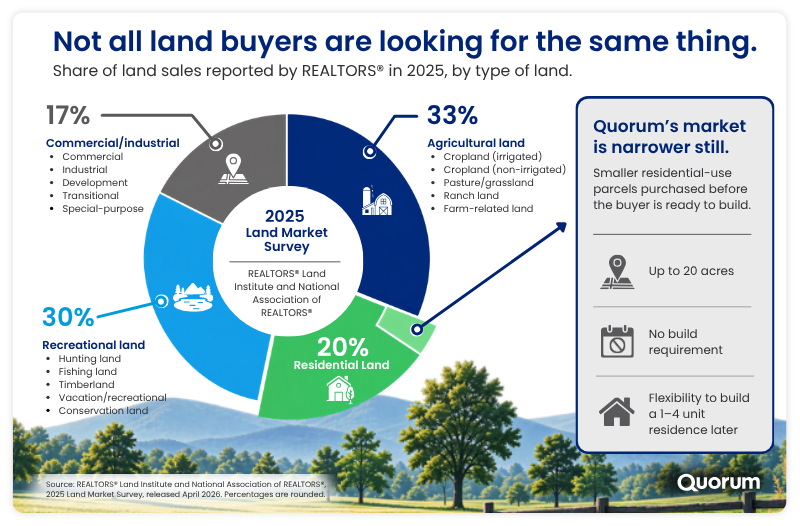
Quorum’s Land Loan was designed for residential-use parcels of up to 20 acres. At closing, the borrower must intend to hold the land as an investment. There’s no build requirement, although the owner may later decide to construct a 1–4-unit residence. The property may be improved or unimproved, provided it meets the program’s residential-use requirements.
The loan offers a 10-year fixed-rate and 10-year amortization, with amounts from $50,000 to $500,000. That shorter amortization means the borrower isn’t simply paying for time. On a hypothetical $100,000 loan at 9.50%, approximately $20,800 of principal would be repaid within three years. The owner has time to decide what comes next while building equity in the land.
Someone ready to build should generally start with construction financing. Someone who has found the right land but isn’t ready to build needs a different option.
That’s the gap this product is intended to fill. It lets the borrower secure the property without immediately choosing a builder, setting a construction schedule or committing to the next loan.
If the owner later decides to build, construction financing becomes a separate decision. I’ll address that process in my next article.
Financing your land purchase shouldn’t make tomorrow’s decisions before the project has taken shape. Sometimes the smartest first step toward building is simply owning the right place to do it.
Mortgage professionals can review Quorum’s Land Loan guidelines and specialty lending resources at Quorum Lending or contact us at mortgagesales@quorumfcu.org.
Sources
1 National Association of Home Builders, Zoning Reform: Trends, Tools and Impact
2 Freddie Mac, Housing Supply: Still Undersupplied by Millions of Units
3 U.S. Census Bureau and U.S. Department of Housing and Urban Development, Monthly New Residential Construction, August 2026
4 National Association of Home Builders, Single-Family Starts Rebound but Market Challenges Persist